So how’s the flip tax so far this year?

We looked last week at how the instability of flip tax revenue keeps our coop’s total revenue unstable. This is significant because (a) we have little control over the health of the real estate market, and (b) flip tax revenue represents between 15% and 28% of our total revenue, depending on the year — it’s our second largest revenue line item (next to monthly maintenance, which is by far our largest).

Flip tax is a significant revenue source that we have no control over and which can vary widely from year to year. That’s very important when understanding the coop’s financial picture.

So while the management office is still struggling to produce financials from last year that our auditors will approve, and while the finance committee of our board has yet to produce an operating budget for the current fiscal year, we can already get a pretty good idea of how the year is going by looking at flip tax revenue so far. And the answer right now is: not too good.

Based on public sales records, flip tax revenue through the first half of the fiscal year is near a low point compared to the past five years:

So far, this year’s flip tax revenue is not even keeping pace with last year’s, which was the worst in while. Will the board need to raise maintenance again to make up another deficit?

The good news is that this year’s flip tax revenue is tracking closely the path of 2013 — the blue line above — which had a nice spring bump. This year may yet turn out fine.

That’s the thing about flip tax revenue: you just never know.

Why are coop revenues unstable?

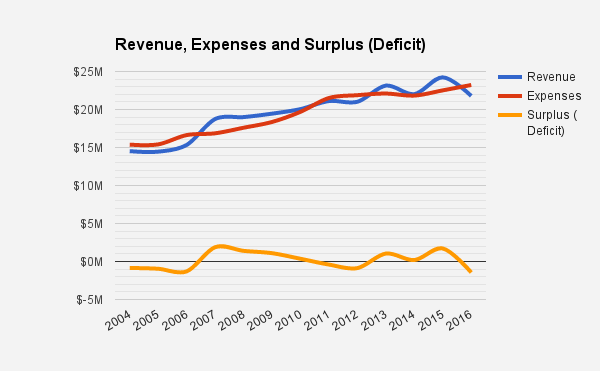
In anticipation of our audited financials being released … someday … I was taking a look at a chart we published in December when the unaudited numbers were distributed just before our annual meeting:

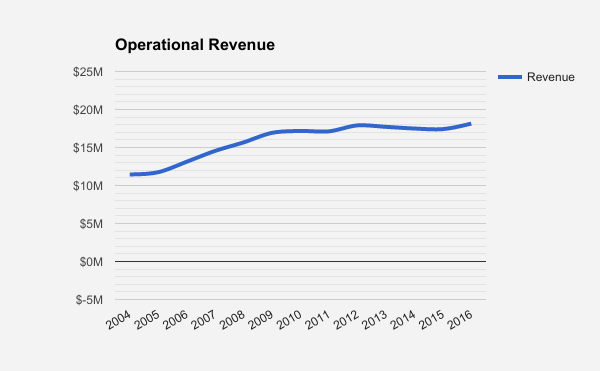
Take a look at that blue line for revenue — why is it so wavy? Our revenue largely comes from maintenance fees, which, until the end of the 2016 fiscal year, hadn’t changed in several years. Most of the rest of the revenue categories are similarly fixed year-to-year: commercial rent, laundry room income, and parking fees. So why the instability?

I took all those stable revenue categories and plotted a line — operational revenue — that looks more predictable:

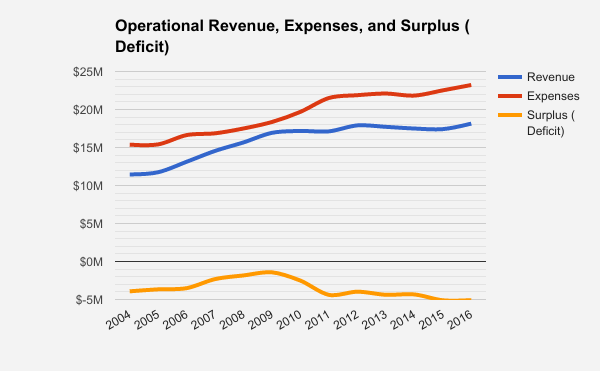
Compare this stable income to our expenses, which are similarly predictable:

That’s too bad — when you take all our predictable revenue and expenses, it looks like the coop is running a significant deficit every year. Over 13 years, that’s an accumulated deficit of over $46 million.

Now in my old coop — a much smaller building in the west village — that would be the end of the story, and we’d be in big trouble. We did have additional revenue from flip tax, but we did not count that revenue in our operational budget because it was highly unpredictable. Some years it was a windfall that we put away into our reserve fund, but other years it was a big fat zero.

But East River is much larger, and we have apartment sales every year. The flip tax from those sales is considerable — it’s our second largest revenue category — and has been built into our annual expectations, filling in the gap between operational revenue and expenses.

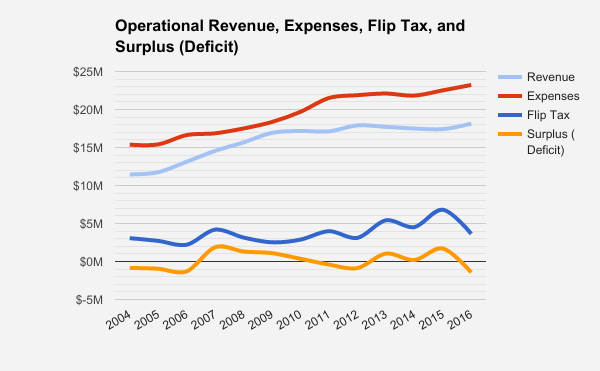
In this chart, I’ve added another revenue line for the flip tax, and the surplus/deficit line has been adjusted to include this additional revenue. (If you were to add these two blue revenue lines together, you would get the original chart at the top of this post.)

Now we can see where the instability of our total arevenue comes from: it directly mirrors the instability of our flip tax revenue. Even more clearly, the wavy line showing our surplus/deficit also rides the flip tax wave.

This dependence on flip tax revenue is not likely to change, it’s baked in to our financial outlook. The only way this coop has ever been in the black is to use that flip tax revenue for operational expenses. In good years we do well, in bad years we don’t, overall it evens out.*

It’s good to keep in mind that the health of the coop is directly related to the health of the real estate market, something we have little to no control over.

*I haven’t included in this analysis the additional $10 million in debt the coop has acquired over the past 13 years. But that’s another story.

Silver’s $79,222 state pension is safe

Pension forfeiture will be on the ballot in November in the form of a proposed amendment to the state constitution. Two successive sessions in Albany have now passed a resolution subjecting the pension benefits of convicted legislators and state officers to court-reviewed reduction, meaning that voters now have the chance to directly approve the measure.

But there’s a loophole for our neighbor Sheldon Silver, convicted in 2015 on federal corruption charges: the new rules would apply only to crimes committed on or after January 1, 2018.

Sheldon Silver currently lives at home, awaiting appeal, collecting a state pension of $79,222. Even if this constitutional amendment is approved, and even if Silver starts to serve out his 12-year prison sentence, New York taxpayers will continue to pay.

LES reacts to executive orders

After spontaneous protests at JFK on Saturday and a large planned rally at Battery Park Sunday, Monday’s Tompkins Square rally was a relatively tame affair — but was still a defiant protest by hundreds of lower east siders in a location of significance to waves of immigrants and various resistance movements.

Speakers included local elected officials — Councilmembers Margaret Chin and Rosie Mendez (who together represent East River Coop); Manhattan Borough President Gale Brewer; Public Advocate Tish James; and District Leaders Carlina Rivera and Anthony Feliciano. Religious leaders from east village churches, synagogues, and mosques also gave moving testimonials to the neighborhood’s history with immigrant communities, refugees, and outsiders.

The Lo-Down posted videos from the rally here:


Someone also shared with me today a post from the beautiful Museum at Eldridge Street housed in the old Eldridge Street Synagogue. It’s a statement of support for immigrants and refugees, as well as reaffirmation of the importance of immigration to the LES: “Our gateway Lower East Side neighborhood — once home to the largest Jewish community in the world — is today a part of a vibrant Chinatown.”

Click for larger image.

Rally in Tompkins Square Park: Monday 6:30 pm

Any way you look at it, it’s been an eventful first week for President Trump, with bombshell executive actions from the Oval Office and unprecedented protests around the country. If you missed last week’s Women’s March, or today’s big rally downtown, or you just can’t get enough, Councilmember Rosie Mendez is promoting a neighborhood rally in Tompkins Square starting at 6:30 pm Monday evening: “Rally Against Hate.”

Community leaders and elected officials will be in attendance. Grand Street residents who oppose the President’s agenda will make ourselves be heard too. If you want to join a contingent of activists from East River, meet at the bus stop on Grand and Columbia at 5:45 — we’ll be taking an M14A bus up to the rally.

If you’re coming on your own, the rally will be in the south end of the Square.

Skyscrapers creep closer and closer

Conceptual drawing of new construction.

With one high-rise by the Manhattan Bridge already cresting above the surrounding buildings, developers have plans for more skyscrapers along the East River — four 700-foot plus towers along the unzoned stretch along South Street.

Residents from the Two Bridges community met with developers and elected officials last week and left with the impression that there was little that could be done to stop the push for massive construction. River views can be extremely attractive to high-paying customers, especially on property so close to Wall Street.

There is potential room for further development all the way up the shore to Jackson Street.

Intercom changes coming soon

The board distributed a memo this week and form for submitting your phone number to be used with the new intercom system.

If you have a landline, you’ll likely just want to use that number, so your home phone will ring as it does now when someone wants to visit.

If you are a mobile household, you can now have the downstairs buzzer ring your mobile phone instead. And you can submit more than one number, so you and your partner can be listed separately. In this case, the board’s memo said to get in touch with Dineen Casiano, Mr. Wollman’s assistant, at (212) 677-5858 ext. 305. I just spoke to her, and she said it’s as easy as submitting two names and two numbers on your intercom upgrade form.

You can download that form –> here.

Neighborhood crime rate stays low in 2016

Mayor De Blasio is promoting 2016 statistics showing New York City crime rates at an all-time low. Meanwhile, the Lo-Down this week covered crime on the lower east side — rape and robbery are up in the 7th precinct, covering the East River to Essex and up to Houston.

But NYPD statistics still paint the 7th precinct as one of the safest in NYC:

Precinct-by-precinct crime rates. (Lighter color is lower.)

And, looking closer, most of those crimes happen along high-traffic areas around Essex and Delancey. Our end of Grand Street is relatively free of crime:

Reported crime locations in 2016.